
Staking
The allocation of at least 7% of RawBlock system's net earnings has been designed to be regularly supplied to the community each month. Individuals creating digital membership cards can participate in the staking pool.
Staking Mechanism Participation Condition
Users who want to participate in the staking pool need to possess their own avatars within the member identity cards (RawBlock (RB) NFTs).
Asset Information Transferred to Staking Pool
- Şirket Adı: Tether
- Web: https://tether.to
- Value type and Value: USDT (~1 USD)
- Whitepapter: https://tether.to/en/transparency/
- Audit(Certik):
https://www.certik.com/projects/tetherutm_source=CMC&utm_campaign=AuditByCertiKLink
- Audit(Fairyproof):
https://fairyproof.com/report/Tether
- Community: https://twitter.com/tether_to
Financial, Psychological and Mathematical Structure of Staking Mechanism
100% 16-month proportional vesting distribution and operational mechanism
- Monthly yield to be transferred to the staking pool: Minimum of 7% (calculated based on the company's monthly net earnings)
- The total waiting period required for individuals participating in the staking pool to fully earn 100% of their income in the pool: 16 M
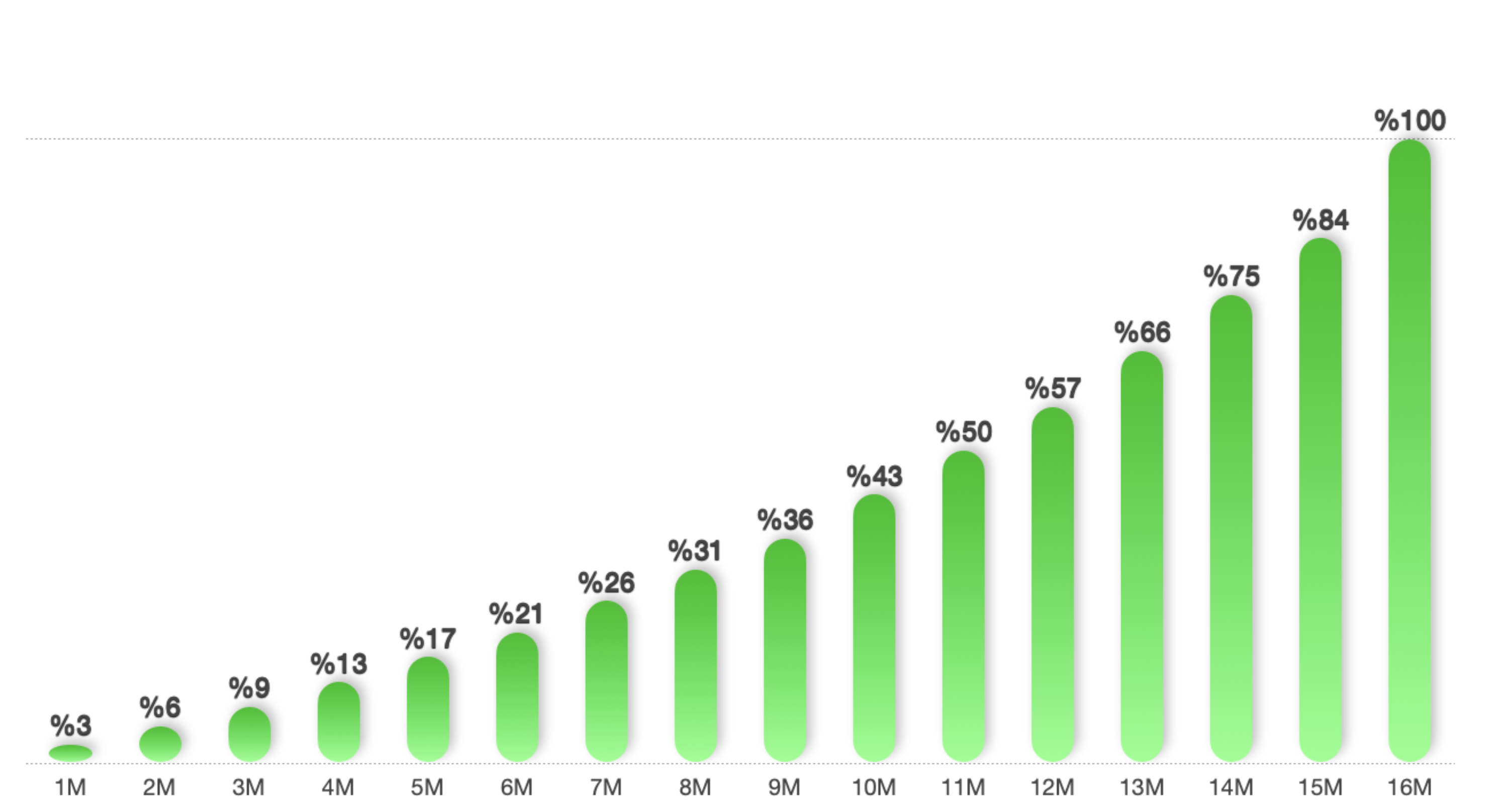
- The distribution of earnings for members participating in the staking pool over a 16-month period is determined by considering the behavioral and psychological aspects of people's expected returns from their financial investments. Users' returns from the pool have been arranged to increase proportionally over the 16-month period. As the maturity date approaches, specifically towards the end of the 16 months, the returns will increase more compared to earlier periods.
In traditional finance theory, the concept of opportunity cost is crucial. As the duration of giving up the use of an asset for investment increases, the expected return from the investment will also increase for the investor. Therefore, the distribution of returns from the staking pool over the 16-month period is designed according to one of the fundamental principles of economic theory, which is opportunity cost. In summary, while small returns are present at the beginning, the return rate gradually increases, reaching 100% towards the end.
Using this approach, the 16-month plan will be as follows:
          Month   1-3     Monthly increase of %3  Total increase  =>  %9
          Month   4-6     Monthly increase of %4  Total increase  =>  %21
          Month   7-9     Monthly increase of %5  Total increase  =>  %36
          Month  10-12    Monthly increase of %7  Total increase  =>  %57
          Month  13-15    Monthly increase of %9  Total increase  =>  %84
          Month    16     Monthly increase of %16 Total increase  =>  %100
Distributing returns in 3-month periods within the outlined framework will contribute to investors forming more effective future planning horizons. Under these conditions, individuals and companies can better align their current economic activities with the aforementioned return distribution. Additionally, distributing returns in this manner will instill a sense of achievement in investors due to the gains they achieve as a result of their activities.
- Users participating in the staking system are required to burn tokens in order to increase their share rights within the pool. Burning each token will increase the percentage of ownership of the NFT on the system.
- There are two primary factors that influence the prices of existing NFTs. The rarity status of the NFTs is the first factor, and the second is the amount of tokens burned. The price of NFTs will be determined based on the relative impact of these two fundamental factors.
- In mainstream economic theory, the fundamental determinant of the value of money is the amount of money in the relevant market. In token economics, after the initial supply process, the amount supplied is the primary determinant of a token's value. The requirement to burn tokens to increase the staking system percentage for RawBlock tokens is designed to support the upward movement of RawBlock token price. Firstly, due to the burning process, the amount of tokens in the system's token pool will decrease, positively impacting the price. This will prevent downward price fluctuations by reducing token sales and allowing the price to stabilize at higher levels. Secondly, after the burning process, the NFT owner's share in the staking pool will increase, consequently increasing the investor's return rate.
⬅️ Previous ⏺️ Home Next ➡️